
Iles Glenan
The rock and roll of island adventures

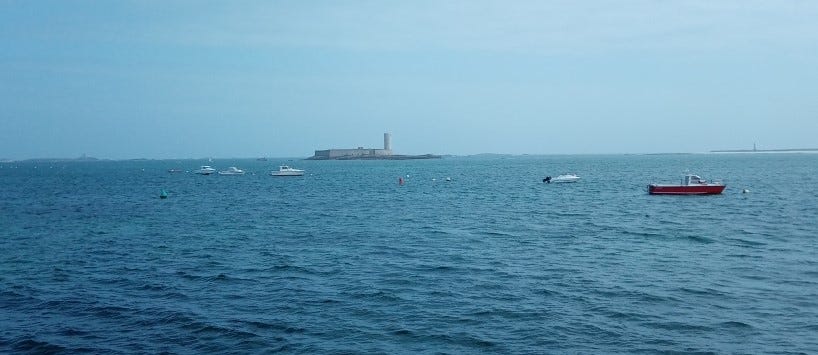
This week I visited the Îles Glénan for the first time. I thought a day in May outside the many bank holidays of the month would be warm and quiet, and was looking forward to a calm day out with my good friends Julia and Phil. We drove south through pelting rain, wrapped up in layers of clothing. The foolish optimist in me was carrying swimming things in my rucksack.
Arriving in Benodet, we braved a blustery wind to walk along the Corniche to the jetty where the Vedettes de l’Odet boats were moored. The usually busy town seemed surprisingly empty. Only nine people were waiting on this unpropitious day, and when we got on board all hurried downstairs and into the closed cabin, despite our initial resolutions to remain outside and enjoy the sea views without restriction on the one hour journey.
Shortly before start time of 13H30, a huge party of French pensioners arrived to completely fill the boat with a presence of vigorous bonhomie perhaps invigorated by the odd drop of drink taken over some restaurant lunch. The three of us huddled in the back corner, inches from the row of large, jovial passengers pressing back the seats in front. Noise levels rose further as we nosed out of the Odet estuary and hit the open sea. The impact immediately threw our little boat from side to side with a violence promising maritime ordeals I had not even considered.
I was by the window, one second looking directly into a wall of water, then next high up with only sky in sight. I have never, in the best of times, been a great fan of rock and roll. The further we went, the greater variety of stomach-turning lurches, up and down, left to right: we all clung on to something or someone to keep our seats. The French pensioners let out a jolly bawl at every pitch and heave. That is, until many of them succumbed to the inevitable consequences and the crew rushed about distributing paper bags and rolls of tissue, escorting the worst affected to the covered outside deck behind.
Still the others chortled, joshing good-naturedly as one old man fell over in the aisle. No-one moved to help him and he floundered about like an up-turned turtle as the boat tossed and turned until two valiant members of the crew hauled him up. It was all a kind of pantomime, on-board entertainment laid on by the ocean to occupy us during the trip. We three had not eaten lunch and remained immune to sea-sickness. I know the rules: don’t look at the waves only at the horizon, but unfortunately it was never still enough to actually see this elusive line, so I spent a lot of time gazing at the ceiling of the cabin, mesmerised by the hysterical cackling of the woman in front of me every time someone vomited. It seemed an interminable journey.
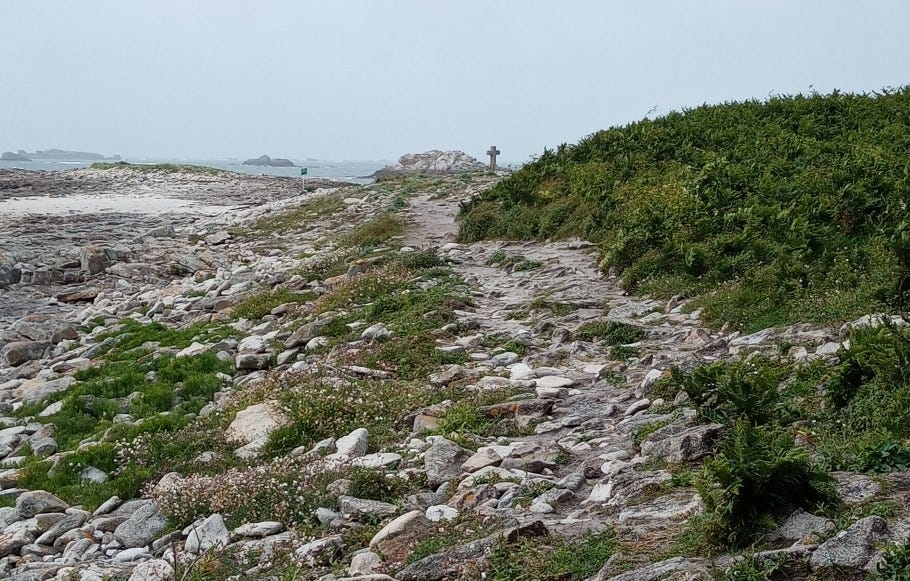
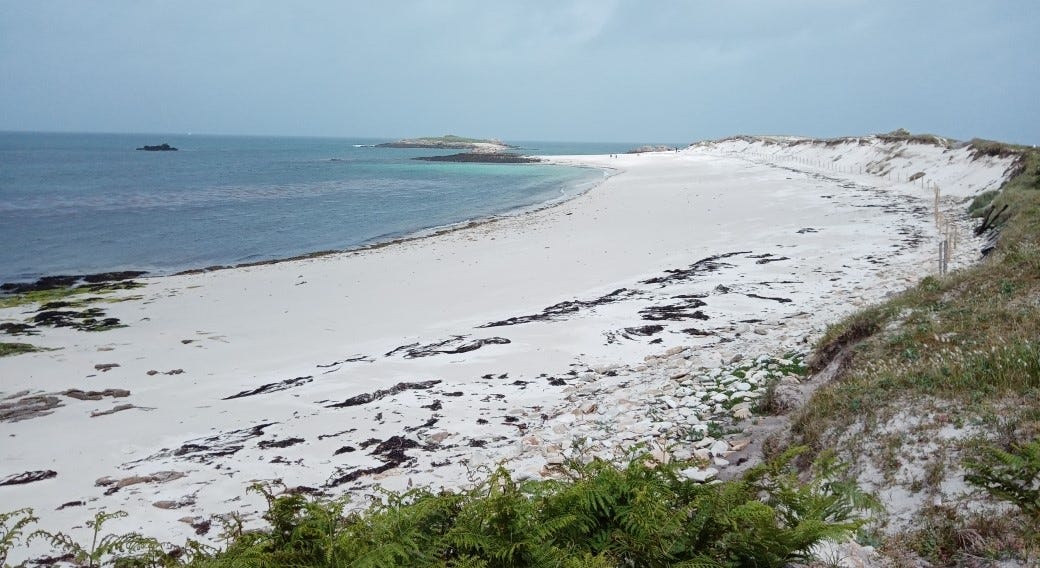
We arrived very late on Saint-Nicolas, the only island of the archipelago directly accessible to the public. Less than an hour was left before we had to re-board for a trip around the other islands, but we were cheerfully assured that the water for this would be calmer. Julia and Phil went off in search of interesting birds while I quickly walked anti-clockwise right around the small territory, looking longingly at the sandy tombolo or spit between Saint-Nicolas and the islet of Bananec, which would be gradually covered during the afternoon as the tide rose.
The Îles Glénan are mostly famous for an internationally renowned sailing school, Les Glénans, started in 1947 and still flourishing today across several islands. There is also the distinction of a unique flower, the Narcissus of Glénan, now protected and blossoming on Saint-Nicolas each spring. The archipelago is a nature reserve, offering shelter to many species of birds, more than 140 during the course of the year. Despite the suitable season, we were not blessed on the water by the sighting of those other regular visitors, basking sharks.
There is nothing particular to see as I walk, no remains of the 13th century priory after which the island is named, but the experience was delightful under a gentle sun, even though the wind still whipped through, fuzzing my photos. The beaches are beautiful (I might even have swum if we had been given the promised hour and a half) and views of the scattered islands are spectacular. These are too numerous to count and range in size from a single mass of rock to sizeable territories like the Île du Loc’h and Île de Penfret. The main ones form a rough circle around a lagoon of the famous aquamarine water, its glowing clarity attributed to fossilised remains of a red seaweed called lithothamne.
Nine main islands form a rough ring and were probably once all one, and even a part of the mainland 17km away in much earlier times as various (unvisitable) neolithic remains suggest. Historically the islands have been sparsely inhabited off and on, mostly by fishermen, since then, and only a handful have any kind of buildings. Folklorist Paul Sébillot (1843-1918) records stories of later connections with the continent, such as the possibility of walking from Beg Meil to the Île aux Moutons, and a spring-time religious procession from Loctudy to one of the islands along a tree-lined avenue. These suggest very ancient oral traditions of the days before the sea rose to fully divide Îles Glenan from the southern coast of Finistere. The archipelago now depends on the commune of Fouesnant.
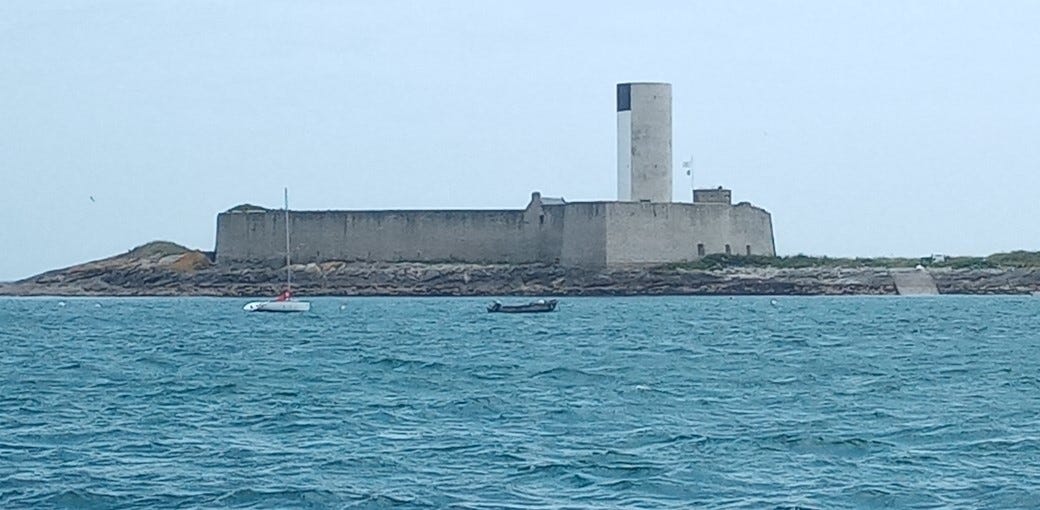
The boat tour gave an excellent perspective of this most unusual site, offering a commentary in French and English about the history and natural features of all the islands we passed close by, although I think most people’s minds were on the moment when we’d leave the protection of the archipelago and strike out for home again. One striking feature on view was the fort on Île Cigogne, founded in 1756 at the height of corsair activities, with English and other pirates finding convenient places to hide among the islands, as Jacques Cambry noted in a text of 1795.
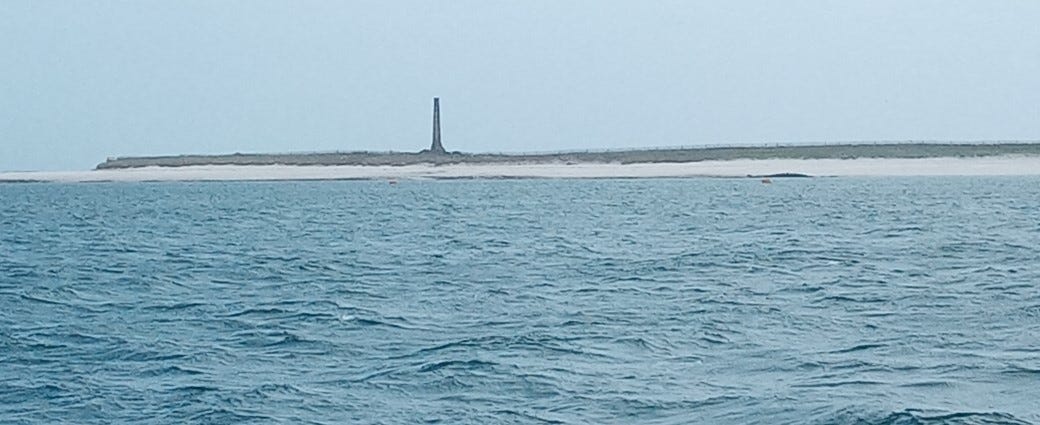
The fortification did little to remedy the problem and was only ever used spasmodically. Its tower (1911) remains as a useful daymark for shipping, like the still-functioning lighthouse on Île de Penfret with its red cupola, and a tall slim structure on Île de Loc’h, rare remnant of a galleried oven for the burning of seaweed in the late 19th century. This large island remains in private hands of the family Bolloré, an industrial dynasty much in the news in France at the moment.
Eventually we plunged back into a swelling sea for the return journey, not against the tide this time so quicker and less eventful, although turbulence still hit from time to time and some poor sufferers were once again convulsed both by nausea and embarrassment. The continued bumps were met by slightly less enthusiastic yelps from the sobered French contingent. Sometimes the story is in the journey not the destination, but I will definitely go back to get that swim in such exceptional surroundings. I thoroughly enjoyed this very original little adventure, but it would need closer acquaintance to feel a real sense of place in such a disparate setting.
Thank you for reading. Please click LIKE if you do.
Lovely article Wendy.
I admit to laughing out loud over your description of the crossing. How a few drinks can turn responsable adults into children! It reminded me of the sailing from Penzance to the Scilly Isles. The 'Scillonian III' is affectionately known as the 'sick bucket' by the locals.
What a journey -- more eventlful than crossing from Roscoff to Cork as we did yesterday! And owning an island -- recently reading about Bolloré's conflicts with film industry professionals and authors.