
Beyond words
Writing spirit of place

How to write about spirit of place? Does general place-writing conjure it up as a by-product? Putting pen to paper about natural spaces has to be more than description, more than a stack of pictorial phrases to render the visuals. What about stories and historical happenings? What about sensations? What we see is often inextricably merged with what we feel, so nature has become a quite emotive theme since the pandemic, lending a new layer of affecting vocabulary.
There is greater neediness tugging at the countryside than ever before and in new ways. We are very demanding. Where people without writing in the distant past laid down hoards of precious metal, inscribed wall-carvings or raised standing-stones to honour places, now we pile up adjectives alongside the little pillars of pebbles and fluttering ribbons. And so much is self-referential, articulated through a funnel of ‘feeling’, a reversion to romanticism that often blocks the sense of natural flow existing apart from us.
The idea of landscape as a text there for our reading goes against my notions of spirit of place. Of course landscape is a human construct, both environmentally and culturally, but that is not all it is. Beyond the curtain lies something on a level of existence that has no reference to humankind. Does the spirit of place dwell here? It is not something tangible nor materially visible. I could never tell you its literal size or shape although this may sometimes seem distinct to me.
It may form from past events, legend or tradition, or far beyond all that in the bedrock of geography and geology. It can emanate from buildings too, but natural elements are usually key for me: earth, stone, water, tree and all their combined embraces. They hold on to so much. I can write about this, describe and hint at significance and symbolic value, the effect on my mood or attitude. But there is something much further away, through the mirror of landscape, and that is a place I can only go alone. As a writer, there is only so far I can follow myself.
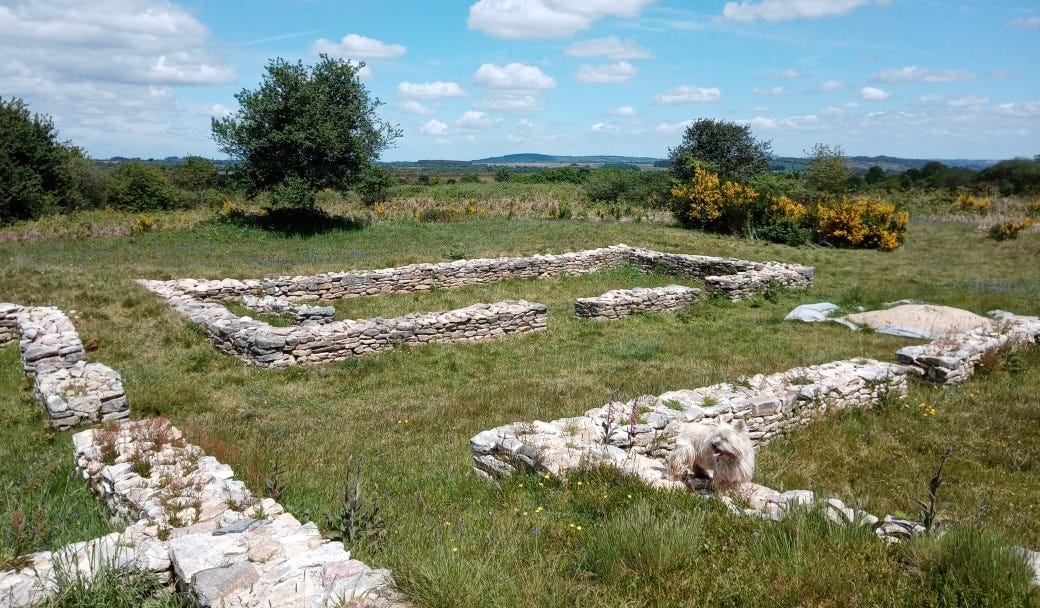
I’m thinking about this at Goënidou, a site I know very well and about which I’ve written on many occasions. Far from other habitation, on the moorland of the Monts dArrée the ruins of a small farmstead remain, one of five originals dating back perhaps to the 13th century. It is an outlier of the Cistercian Abbaye du Relec, nearly 4km to the north. But this is not about history today, at least not in a linear sense.
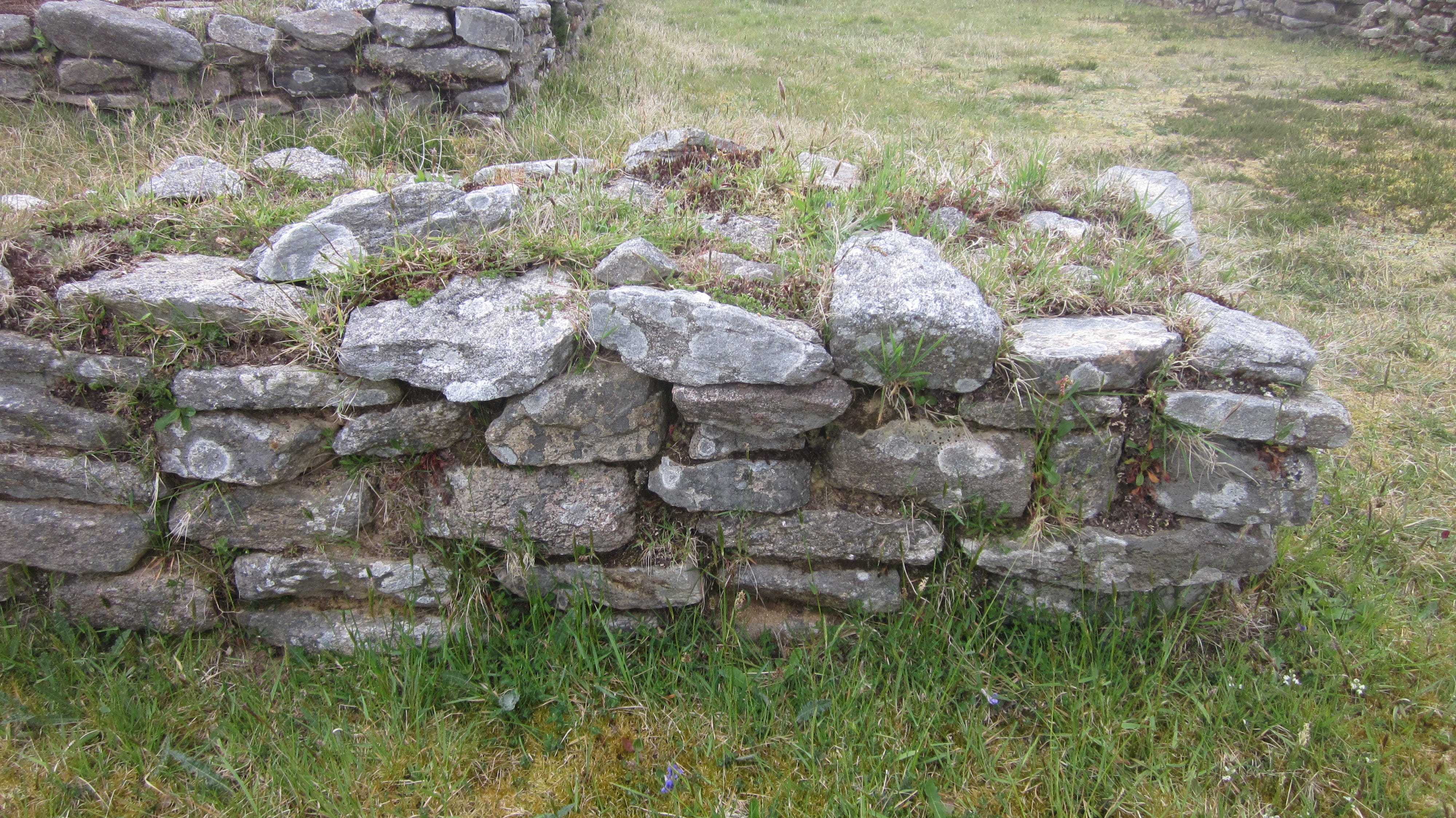
It’s a bright sunny afternoon in May, belying that strong wind driving chilly music across the asperous heath, for this is always a vociferant playground of air. Air the element that speaks to me beyond all others, stirring up or soothing down, driving reactivity. I sit on a pile of cut stone and inevitably lay out a few adjectives, ready for construction, a rather lighter task than the dry-stone-walling of the medieval remains.
isolated remote outlying inaccessible apart off the beaten track lonely
On a day like this sunshine and flowers are all around, but those first locational words drive the imagination towards the lengthy journey to the abbey over hill and bog in winter time. They stride further than the immediate images laid out before me. I think of those very first settlers labouring to clear the ground of moorland vegetation before laying out their fields and gardens, searching for stone to build the shelters whose remains I can see. Architecture here is an essential element at the surface level, what we first see and respond to.
That conjures the solidity of heavy nouns:
endeavour struggle toil sweat weariness drudgery industry
All this is the evidence of the site, prompting deductions of experience in practical life terms. Human effort we can all relate to in one way and another, despite the intervening centuries. This perception is a contributory factor but it does not do enough alone to define the spirit of place. Perhaps it does too much, in the familiar pull to place humans at the centre of every situation, to regard the life of the land as solely in their hands.
Today at Goënidou the strongest immediate effect is all in verbs:
inhale identify listen imbibe watch distinguish contemplate
My senses are taken over by the scene. I can breathe in all the heathland scents whipped up on the wind, and smell the dazzling gorse. My eyes absorb all those zesty colours, so bright they are almost speaking: yellow ragwort, bluebells, the cerise sheath of early foxgloves, bursting purple clover, green ferns unfurling. The noise of crickets is deafening, soon joined by a lone cuckoo starting up his tedious litany somewhere near the rough track that brought me here.
After a few minutes of peaceful sitting, I let it all go on regardless and wait attentively.
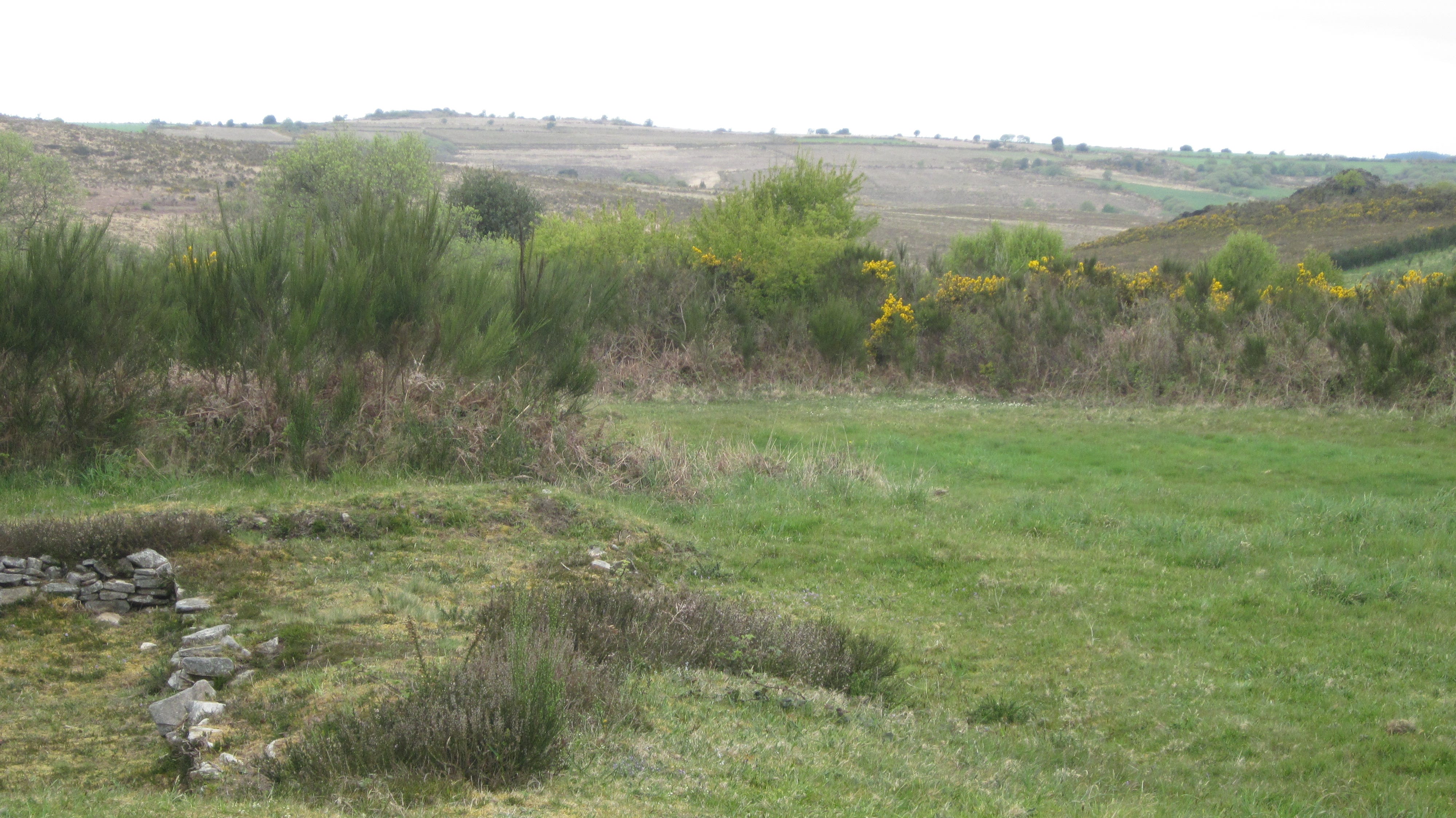
There’s that lull. This top layer of reality in my physical surroundings begins to slip away. Only then do I close my eyes, waiting for transformation, waiting to lose sound and colour in my blindness. Silence comes like a wave stifling the breezy clamour with gentle force. It draws me onto something, somewhere deep within this place, sensing the thing without a name that rises slowly from earthed roots to defend the honour of where and what has been. Landscape cloaks around so I am inside its wrapping, beyond dimension.
And then, through some inherent assimilation, I know something I didn’t know before.
But it is not a call to words. Sometimes words get in the way. The point of mysteries is not to tell; to know and be silent, as pagans say. This is about some arcane knowledge that defies expression. The revelation is intensely personal because it is an acknowledgement of participating presence. Not at, but within a place. Not self, but being. And when the moment comes, it is beyond emotion, a purity of existence, a participation in what is, which has no need of language.
Thank you for reading. Please click LIKE if you do
Perfect. Love this: 'Beyond the curtain lies something on a level of existence that has no reference to humankind. Does the spirit of place dwell here? It is not something tangible nor materially visible. I could never tell you its literal size or shape although this may sometimes seem distinct to me.' YES!
Also like 'vociferant playground'. Mmmm.
I've STILL never been to Goënidou.
This is an astonishing piece of writing. I love the movement from the intellectual wondering about what spirit of place is to the bodily being in the place and those lists doing so much sensory work to the interior experience that is both beyond words yet communicated in the gaps of what is not said, that rests so beautifully in the final words: "an acknowledgement of participating presence. Not at, but within a place. Not self, but being. And when the moment comes, it is beyond emotion, a purity of existence, a participation in what is, which has no need of language." Gorgeous architecture of a piece of writing has led us there.